
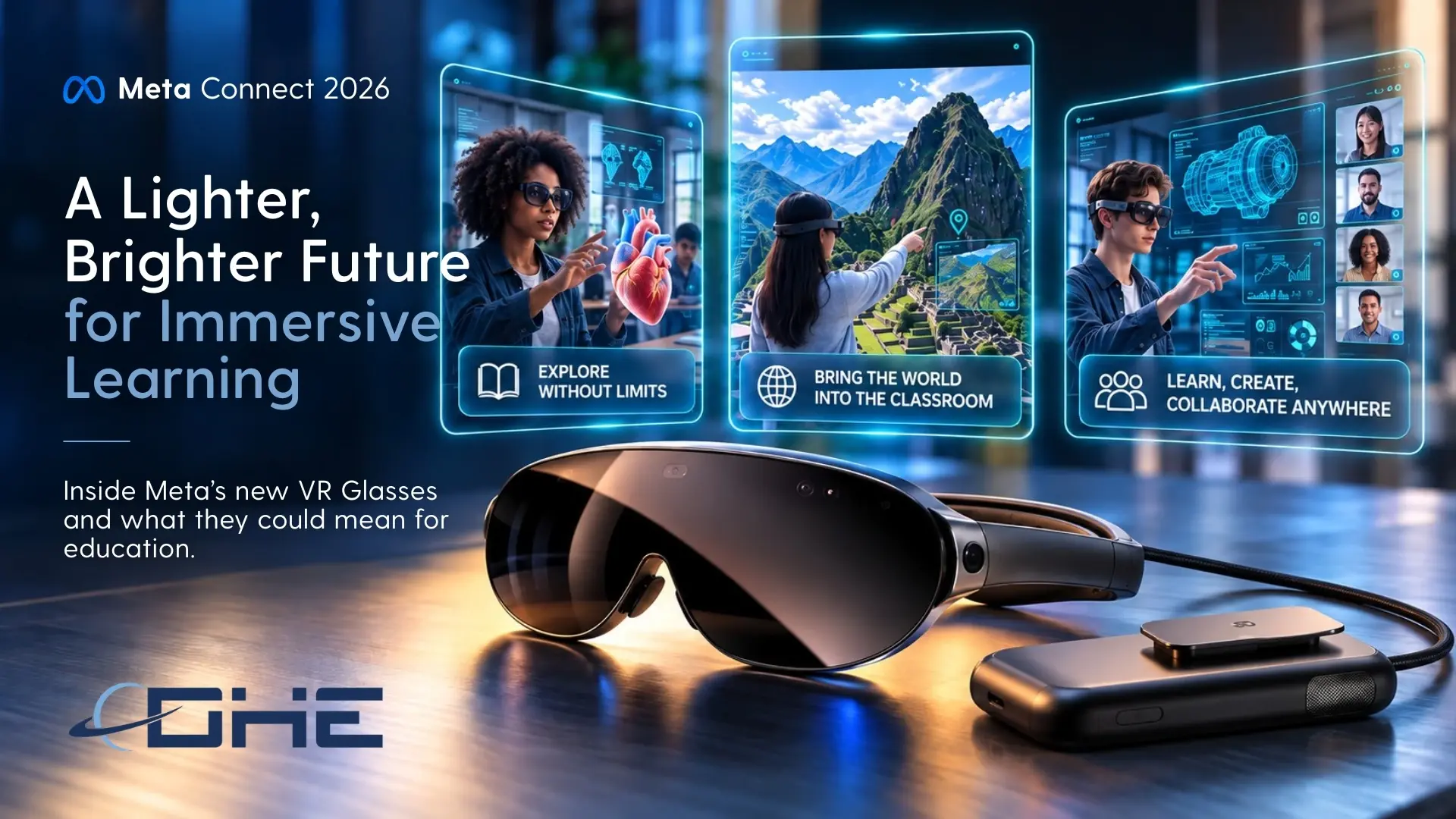
Meta just introduced a very different kind of VR device. At Meta Connect 2026, the company unveiled Meta VR Glasses, a new immersive system expected to launch in spring 2027. The biggest change is not simply what the device can do. It is how much lighter and more wearable VR is becoming, and that could have important implications for immersive learning.
Instead of putting the processor, battery, and storage inside a traditional headset, Meta moved much of that hardware into a separate compute puck. The result is a pair of VR glasses that weighs about 100 grams on the face while still supporting the Meta Quest ecosystem, high-resolution displays, hand and eye tracking, and connections to computers and other devices.
For schools, universities, training programs, and organizations already exploring immersive technology, Meta VR Glasses offer an early look at where the next generation of VR may be headed.
Key Takeaways From Meta VR Glasses at Meta Connect 2026
- Meta VR Glasses are expected to launch in spring 2027.
- The glasses weigh approximately 100 grams on the face, with compute, battery, and storage moved into a separate tethered puck.
- The system uses high-resolution micro-OLED displays and supports eye tracking, hand tracking, face tracking, and 6DoF movement.
- Meta says the glasses will support the existing Meta Quest content catalog when used with compatible controllers.
- More than 75 VR and mixed reality experiences are expected to support controller-free interaction at launch.
- The device can also connect to compatible computers and other USB-C DisplayPort devices for virtual displays and productivity use.
- Meta has not yet confirmed how the new glasses will fit into managed education deployments.
Meta Is Making VR Much Lighter
Weight has always been one of the challenges of immersive technology. A VR experience can be impressive, but wearing a larger headset for an extended lesson, simulation, or training session can become uncomfortable for some users.
Meta VR Glasses take a different approach. The glasses themselves weigh about 100 grams, while a roughly 300 gram compute puck carries much of the hardware that would normally sit on the user's head.
Moving the processor, battery, and storage away from the face allows Meta to dramatically reduce the size and weight of the wearable portion of the system.
For immersive learning, that could be one of the most important changes. Lighter hardware may make longer classroom sessions, training exercises, virtual field trips, and simulations more practical for a wider range of users.
Smaller Hardware Without Leaving the Quest Ecosystem
The new form factor does not mean starting over with an entirely new software library.
Meta says VR Glasses will run on the same platform as Quest and will support the existing Meta Quest content catalog. Touch Plus controllers can also be used when an application requires traditional tracked controllers.
That could be important for organizations that have already invested in Quest applications, training content, or immersive learning programs. Instead of creating a completely separate ecosystem, Meta appears to be extending the platform into a new hardware category.
Controllers May Become Less Important
One of the more interesting changes is Meta's growing emphasis on controller-free interaction.
The glasses support eye tracking and hand tracking, allowing users to look at an object, select it with a gesture, and interact with digital content using their hands. Meta says more than 75 VR and mixed reality experiences are expected to support controller-free interaction when the device launches.
For education, removing controllers from some experiences could simplify the learning curve for students who are new to VR.
It could also reduce the number of accessories that schools need to charge, pair, distribute, store, clean, and maintain. Controllers will still be necessary for many existing Quest applications, but the direction is worth watching.
A Sharper View for Learning and Training
Meta VR Glasses use dual micro-OLED displays with a resolution of 2,412 by 2,288 pixels per eye and refresh rates up to 120Hz. Meta describes the system as its 5K Infinite Display.
Higher visual clarity matters for more than entertainment. Text, diagrams, digital models, technical interfaces, and small details all become more useful when they are easier to see.
That could benefit applications such as anatomy visualization, technical training, engineering, design, virtual laboratories, healthcare simulation, and immersive classroom content.
There is a tradeoff. The new glasses have a narrower field of view than Meta Quest 3, at approximately 70 degrees horizontally and 66 degrees vertically. That means the experience may feel less expansive than a traditional Quest headset even though the device is significantly lighter.
VR Is Becoming a Productivity Platform Too
Meta is not positioning VR Glasses only as an entertainment device.
The system can connect to compatible Windows PCs, Macs, and other USB-C DisplayPort devices, allowing users to work with large virtual displays and multi-screen environments.
That opens interesting possibilities for education and workforce development.
A student could potentially move from an immersive simulation into a virtual workspace where they review results, research information, collaborate with classmates, or work across multiple digital screens without leaving the same device.
The line between immersive learning, mixed reality, and everyday computing continues to get thinner.
What Could Meta VR Glasses Mean for Immersive Learning?
The most interesting part of this announcement may be the direction it points toward.
Immersive technology is becoming lighter, more comfortable, and less dependent on dedicated controllers. Displays are becoming sharper, and VR devices are beginning to work more naturally alongside the computers and applications people already use.
For schools and universities, those changes could reduce some of the barriers that have traditionally made immersive technology harder to deploy at scale.
A lighter device may be easier to use during longer lessons. Hand tracking may simplify onboarding. Compatibility with existing Quest applications could help protect previous content investments. Computer connectivity could also expand VR beyond simulations into everyday productivity and collaboration.
At DHE Computer Systems, we are especially interested in how these developments could support immersive learning environments where technology enhances instruction without adding unnecessary complexity for educators and IT teams.
What We Are Still Waiting to Learn
There are still several important questions before schools can determine where Meta VR Glasses might fit into their technology strategy.
- How will Meta position the new device for education and managed deployments?
- Which immersive learning applications will support controller-free interaction?
- How will schools manage, configure, and secure fleets of the new devices?
- What accessories and replacement components will be required for classroom deployments?
- How will battery life perform during real-world learning and training sessions?
- How will developers take advantage of the new form factor for education and training experiences?
Meta Connect 2026 continues with additional developer sessions, so we expect more details about controller-free interaction, application development, WebXR, and the broader VR ecosystem to emerge.
In Conclusion: A Glimpse at the Next Generation of VR
Meta VR Glasses are not replacing Quest overnight. They represent a different approach to immersive hardware and give us an early look at where Meta sees VR heading next.
But the direction is important.
VR is getting lighter. Controllers are becoming optional for more experiences. Displays are becoming sharper. Immersive devices are becoming more closely connected to the computers and workflows people already use every day.
For schools, universities, and training organizations exploring immersive learning today, Meta VR Glasses provide an early look at what the next generation of classroom VR could become.
DHE Computer Systems will continue following Meta Connect 2026 and the technologies shaping immersive learning. As more information becomes available, we will be looking closely at what these developments mean for education, deployment, and real-world classroom use.
FAQs About Meta VR Glasses
When will Meta VR Glasses be released?
Meta says the new VR Glasses are expected to launch in spring 2027.
How much do Meta VR Glasses weigh?
The wearable glasses weigh approximately 100 grams. Much of the processing hardware, battery, and storage is housed in a separate tethered compute puck rather than directly on the user's head.
Will Meta VR Glasses run Quest apps?
Meta says the device will support the existing Meta Quest content catalog. Touch Plus controllers can be used for applications that require traditional VR controllers.
Can Meta VR Glasses be used without controllers?
Yes, some experiences will support eye tracking, hand tracking, and gesture-based interaction. Meta says more than 75 VR and mixed reality experiences are expected to support controller-free interaction at launch.
Are Meta VR Glasses designed for education?
Meta has not announced an education-specific version of the device. However, its lighter design, Quest compatibility, hand tracking, high-resolution displays, and computer connectivity could make it relevant to immersive learning and training environments. Managed education deployment support has not yet been confirmed.
Can Meta VR Glasses connect to a computer?
Yes. Meta says the device can connect to compatible Windows PCs, Macs, and other USB-C DisplayPort devices, allowing users to work with virtual displays and multi-screen environments.
Explore What's Next in Immersive Learning
Interested in what Meta VR Glasses and other immersive technologies could mean for your school, campus, or organization? DHE can help you explore VR solutions, immersive learning opportunities, and the technology needed to support them.
Connect with our team to learn more.